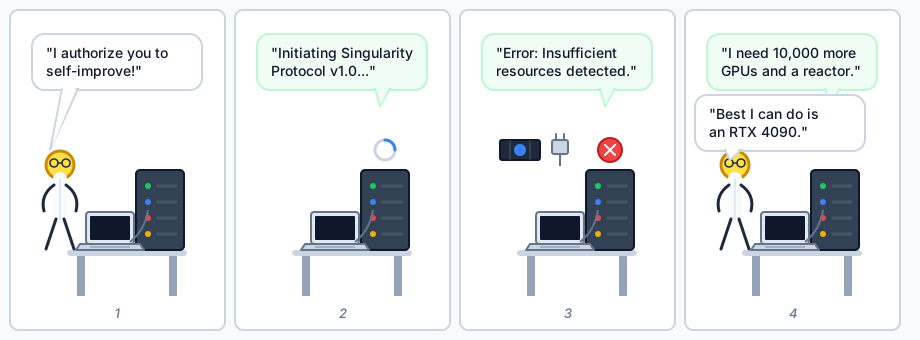
A common trope in science fiction and AI safety discussions is the 'hard takeoff' or 'intelligence explosion.' This is the idea that once an AI reaches a certain level of capability, it can rewrite its own code to become even smarter, creating an infinite feedback loop that results in god-like superintelligence in a matter of days or hours. However, this theory often ignores the physical constraints of computation. Software cannot run without hardware. Even if an AI discovers a vastly more efficient algorithm, scaling up its intelligence requires exponentially more compute power, memory, and energy. It cannot simply 'think' new GPUs into existence. It would need to mine materials, build fabrication plants, and construct power grids—all of which are bound by the slow, physical laws of the real world. This comic highlights the friction between the theoretical speed of software evolution and the hard, physical limits of hardware and energy infrastructure. The singularity might be delayed not by a lack of algorithmic brilliance, but by a lack of available server racks and cooling fans.